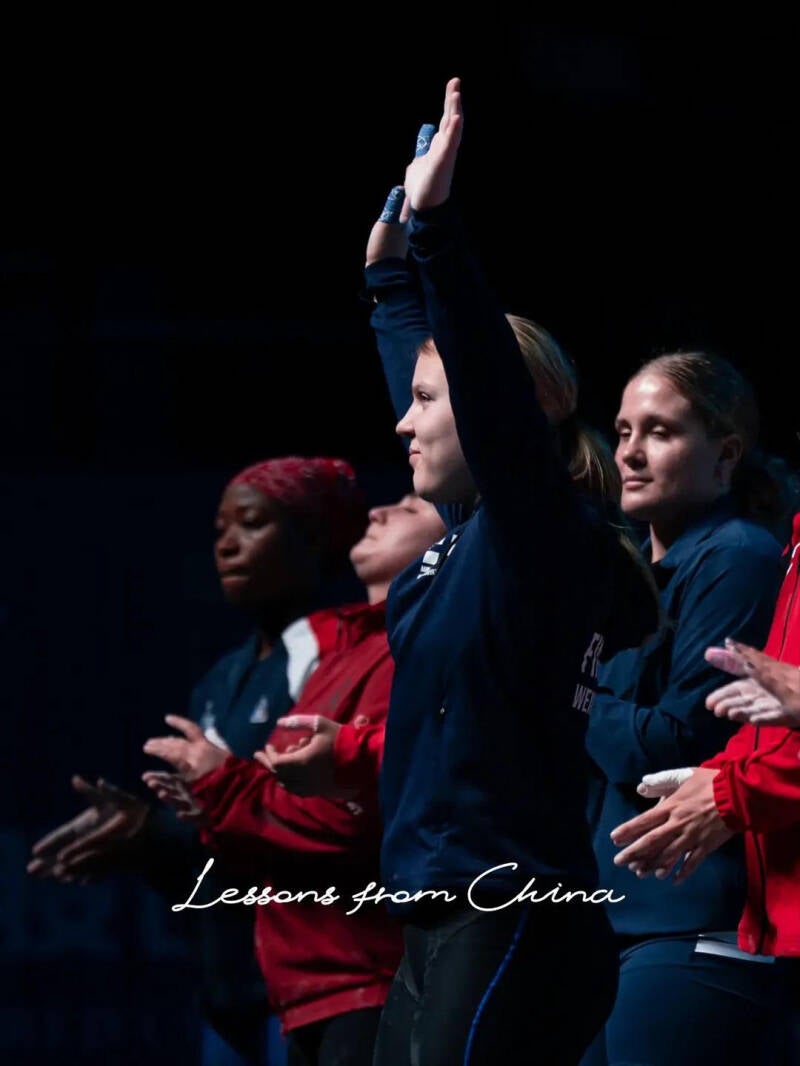
Photo borrowed from Lauras Instagram post, photo taken by All Thing`s Gym.
After the World Championships in Ningbo, Laura Niemelä shared a reflection on Minni Hormavirta's competition that stuck with me.
Laura explained that many parts of the preparation had gone well. Travel, training, time-zone adjustment and competition preparations were largely successful. Yet one thing became apparent during the competition. Minni had struggled to eat enough in unfamiliar environments. After already losing weight during the Junior European Championships in Albania a few weeks earlier, the effect had accumulated. By the time she reached the World Championships, the muscles were simply too empty.
"The muscles were too empty, the body felt loose, and no amount of fueling up or power of will can override that."
Read the full post here: https://www.instagram.com/laura_speedsters?vrfl=Z29mZzE0OTU4Mmxw
When I read that, a lot of things suddenly made sense.
Watching from home, I had noticed something felt slightly different compared to Albania or the regional competition in Pori. Not dramatically different. Minni still lifted well. She did not suddenly forget how to snatch or clean and jerk. But there seemed to be a small difference in sharpness, explosiveness and confidence under the bar.
As spectators, we tend to look for technical explanations.
"The pull was short. The extension wasn't finished. The jerk lacked commitment. The turnover wasn't fast enough."
But Laura's post reminded me that sometimes the explanation starts weeks before the athlete ever steps onto the platform.
And it made me think about how many variables surround an athlete at a major championship.
The Competition Nobody Sees
One of the things that struck me most after reading Laura Niemelä's reflection was how little spectators actually see of an athlete's performance.
Fans see six attempts and a result on the scoreboard. Coaches see months of preparation. Athletes live every hour of the process.
By the time a lifter walks onto the World Championships platform, the competition has already been going on for weeks. The lifts in front of the audience are only the visible part of the story. Behind them are hundreds of decisions, routines, adjustments and challenges that ultimately shape what happens under the barbell.
At a local competition, talent and strength can often compensate for small imperfections in preparation. At the World Championships, everyone is talented. Everyone is strong. Everyone has trained hard enough to be there. The higher the level becomes, the more important the margins become.
More Than Just a Flight
Take travel, for example.
A trip from Finland to China sounds simple when written on a schedule, but athletes experience it very differently. Long flights, airport transfers, queues, delays, dehydration and interrupted sleep all place stress on the body before the competition even begins.
How much sleep did the athlete actually get on the plane? Were they able to relax? How well do they recover sitting in a cramped seat for ten or twelve hours?
Sometimes athletes arrive physically at their destination while a portion of their recovery still seems to be somewhere over Siberia.
From the outside, these things appear insignificant. For athletes competing at the highest level, they can matter enormously.
Living on a Different Clock
Then there is the time-zone adjustment.
The competition schedule may say that the athlete lifts at seven in the evening, but the body follows biology, not paperwork. Depending on the time difference and individual adaptation, an athlete's internal clock may disagree completely with the official competition schedule.
Some athletes adjust rapidly. Others take days to find their rhythm. Even when an athlete appears alert, physiological readiness may be something entirely different. Strength, explosiveness and reaction times are all influenced by sleep and circadian rhythm.
The Challenge of Eating Abroad
Laura's post highlighted something I had not considered strongly enough: eating enough in unfamiliar environments can itself become a challenge.
As spectators, it is easy to think that nutrition is simple. If an athlete needs more energy, they should simply eat more. Reality is often more complicated.
Food may be unfamiliar. Menus may be impossible to read. Some athletes have allergies, sensitivities or dietary restrictions. Others simply struggle with appetite while travelling. Add the stress of competition and suddenly maintaining normal eating habits becomes surprisingly difficult.
A small calorie deficit over a few days may not show itself immediately. A small calorie deficit accumulated over several weeks can.
That was the insight that made Laura's explanation resonate with me. The athlete didn't suddenly become weaker. The athlete didn't suddenly lose technique. Instead, several small factors combined over time and eventually became visible on the platform.
Adapting to a New Environment
Travel also means adapting to a completely different environment.
The food is different. The water is different. The climate may be different. Humidity, temperature and even local bacteria may be unfamiliar to the body.
Athletes often become extremely cautious because the last thing anyone wants is to become sick before competing. Something as simple as an upset stomach, which would merely be annoying during a normal training week, can compromise an entire championship preparation.
Even maintaining hydration can become more difficult when routines change.
The Hidden Cost of Being a Foreigner
Another factor that athletes often mention is the mental effort required simply to function in a foreign country.
Imagine spending several weeks in a place where you cannot read the signs, understand the language or instinctively navigate everyday situations. Small tasks that require no thought at home suddenly require concentration.
You need to think about transportation, food, communication and basic logistics. None of these challenges are dramatic on their own, but together they create mental fatigue.
And like physical fatigue, mental fatigue accumulates.
Even the Training Hall Is Different
Athletes often notice details that spectators never consider.
A different barbell might feel slightly different in the hands. The platform may respond differently. The warm-up room may have a different atmosphere than what the athlete is accustomed to.
Temperature, lighting, noise and space all influence preparation. Elite athletes are exceptionally good at adapting, but adaptation itself demands energy.
Nothing exists in isolation.
Then There Is Life
Not every variable arrives from competition logistics.
Athletes are still people.
Some are balancing studies. Some are balancing work. Some are carrying stress from family situations or personal challenges. Others are managing injuries, recovery concerns or uncertainty about future selections.
For female athletes there can also be additional considerations related to hormonal fluctuations and the menstrual cycle. While scientific research has not consistently demonstrated major reductions in performance, many athletes and coaches report noticeable variations in recovery, hydration, comfort and energy levels throughout the month. It remains an area that deserves more research and understanding.
The key point is that elite athletes are not machines. They bring their entire lives with them onto the platform.
Why Minni's Result and Story Of What Happened Is Important
This is why Laura's post changed my perspective on Minni Hormavirta's World Championships performance.
Before reading it, I saw a 232 kg total, three kilograms below her personal best.
After reading it, I saw something else entirely.
I saw a young athlete making her senior World Championships debut after weeks of international travel and competition. I saw an athlete dealing with factors that were completely invisible to spectators. I saw someone who missed two clean and jerks, faced real pressure on her final attempt and still found a way to secure a result.
It looks like resilience.
It looks like determination.
And perhaps most importantly, it looks like a young athlete learning how to compete in one of the most demanding environments our sport can offer.
The Higher the Level, the Smaller the Margins
What Laura's post ultimately reminded me is that athletes are not simply competing against the weight on the bar.
They are competing against fatigue, travel, disrupted routines, poor sleep, unfamiliar environments, nutritional challenges, illness risk, stress and countless other variables that most fans never see.
At the World Championships, the differences between success and failure are often measured in remarkably small margins. Sometimes a missed lift begins days earlier. Sometimes it begins weeks earlier.
And sometimes a result that appears “ordinary" on paper turns out to be one of the most impressive performances of all, because of everything the athlete had to overcome just to get there.
What do you think? Do you have stress factors going into a meet?
Comment below and join us in conversation.
Tytti Fygster
Add comment
Comments